
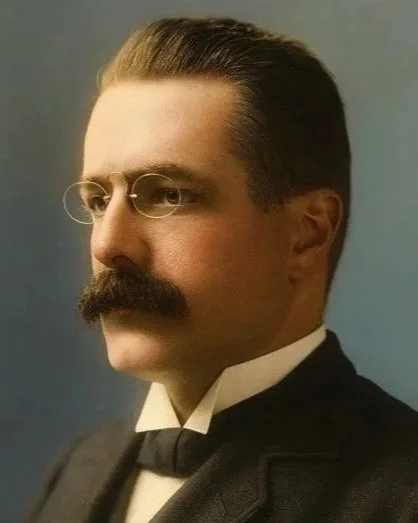
EPISODE 1: Man of Merit
We open in Buffalo, New York - September 6, 1901. A packed exposition hall. Organ music. A line of ordinary Americans waiting to shake the hand of their president. Cortelyou stands close — watching, always watching — as a man with a bandaged hand steps forward and the world changes forever. Then, hard cut to Brooklyn, 1880. A young George Cortelyou sits at a piano, his teacher's daughter Lily watching from the doorway.
The episode unfolds as an origin story built on a radical premise: in a Washington ruled entirely by patronage, connection, and inherited privilege, one young man rises purely on merit. We see the formation of everything that will define him — his remarkable shorthand, his photographic memory, his instinct to organize chaos, and his rare ability to make powerful men feel both managed and respected. When he finally stands before President Cleveland and admits, unprompted, that he is a Republican working for a Democratic president, Cleveland's reply lands like a declaration of the entire series: "I don't care a damn about your politics. There are no politics in confidential relations."

EPISODE 2: Assassination
Now Private Secretary to President McKinley, Cortelyou proves himself indispensable in the chaos of the Spanish-American War — running what amounts to the first modern presidential war room, managing the press, and forging a deep, almost filial bond with a president who trusts him above all others. Then comes Buffalo.
Cortelyou had twice removed the public reception at the Temple of Music from the schedule. McKinley restored it each time. When the shots are fired, it is Cortelyou who catches the falling president. It is to Cortelyou that McKinley whispers his last coherent words: "My wife — be careful how you tell her. Oh, be careful." The next eight days are a masterclass in crisis management under unbearable personal grief. Edison's experimental X-ray machine sits unused in another building. The best surgeon in Buffalo is in Niagara Falls. A gynecologist operates by reflected sunlight off a metal bedpan. Cortelyou manages the press, holds together the grieving First Lady, and issues official bulletins to a stunned nation — all while knowing, with the cold certainty of a man who reads every room, that this president is not going to survive.
EPISODE 3: Architect
Theodore Roosevelt arrives at the White House like a weather system — and George Cortelyou must decide whether to become an umbrella or a lightning rod. As the new president charges Cortelyou with transforming the White House into a professional organization, we watch the world's most orderly man attempt to systematize the world's most disorderly president. The tension is comic, profound, and genuinely dramatic in equal measure.
The episode's political centerpiece is Roosevelt's invitation to Booker T. Washington to dine at the White House — a seismic moral act that triggers furious Southern backlash. Cortelyou must manage a press and political firestorm while inwardly admiring a president who simply does not care what the political cost is when he believes something is right. And then, into this already volatile atmosphere, enters Alice Roosevelt — seventeen years old, freshly installed as First Daughter, and constitutionally incapable of following a single rule anyone has ever made. When Cortelyou first attempts to manage Alice's public behavior, she looks at him with a smile that says she has already calculated exactly how this is going to go.
EPISODE 4: Public Interest
Roosevelt takes on J.P. Morgan and the Northern Securities monopoly in the Supreme Court, and Cortelyou is handed an extraordinary assignment: build the Department of Commerce and Labor from scratch — the first new Cabinet department in decades, created specifically because the country is changing too fast for the existing government to keep up. Meanwhile, First Lady Edith Roosevelt oversees the architectural transformation of the White House itself, commissioning the creation of the West and East Wings. The building being modernized outside mirrors the government being modernized within.
The episode closes with a stunning sequence: Roosevelt disappears into Yosemite Valley for four days with naturalist John Muir, camping beneath the Ponderosa pines. Cortelyou, back in Washington, manages the government alone. It is the first time in years he is not in the same building as the president — and the quietest, most revealing portrait of the man we get. What does George Cortelyou do when the president is not there to need him?
ESPISODE 5: Influencer
Cortelyou reluctantly agrees to manage Roosevelt's 1904 reelection campaign — and immediately discovers that running a presidential campaign for the most famous man in America requires an entirely different set of skills than running the White House. When press accusations surface that he is accepting large donations from the very corporate interests Roosevelt has publicly attacked, Cortelyou faces the first genuine threat to his most prized possession: his reputation for integrity. In a scene that crackles with tension, he confronts Roosevelt directly: "Everything you write down goes to history, Mr. President. And so does everything I do."
Against this political storm, Alice Roosevelt's White House wedding to Congressman Nicholas Longworth becomes the social event of the decade — and Cortelyou, who organized the logistics, watches it with the complicated feeling of a man who has spent his entire career making other people's most important days run smoothly. Alice, radiant and uncontainable, catches his eye across the East Room. In that glance is everything neither of them will ever say.
EPISODE 6: Gateway to Freedom
As Postmaster General, Cortelyou throws himself into modernizing an institution that touches every American life — championing automobile delivery, overhauling rural mail routes, and quietly taking a struggling young clerk under his wing. It is the least glamorous and most quietly important role he has yet held, and the episode finds him most fully himself: systematic, humane, and profoundly capable without an audience.
The episode's emotional heart belongs to the women. Lily Cortelyou and Edith Roosevelt, both largely invisible to history, find common ground over a shared outrage: at Ellis Island, female immigrants are subjected to invasive, humiliating questioning by male officials, entirely unchecked. Their quiet campaign to change this — working through channels their husbands control without their husbands fully knowing it — is the series' most pointed commentary on who actually held things together in the Progressive Era. It also deepens our understanding of Lily Cortelyou as a woman of substance and conviction in her own right, not merely a supportive presence in the background of her husband's story.
EPISODE 7: The Panic
October 1907. The American economy is unraveling. Reckless speculation and unchecked corporate power have triggered a cascading bank run — and there is no Federal Reserve, no deposit insurance, no mechanism of last resort. Just fear, and Cortelyou. As Treasury Secretary, with Roosevelt abroad and the financial system in freefall, Cortelyou enters the most consequential rooms of his career: private meetings with J.P. Morgan, John D. Rockefeller, and the titans of American finance. He is the least powerful man in those rooms by wealth. He is the most powerful by nerve.
Running beneath this financial thriller — and giving it its devastating human dimension — is a personal catastrophe: Cortelyou's nine-year-old daughter Hazel dies of diphtheria. The man who has spent his entire career holding everyone else's world together must now hold his own. He does not break down publicly. He does not stop working. And that restraint — that terrifying professionalism in the face of private devastation — is the most revealing thing the series has shown us about him. Lily's grief, uncontained where his is held rigid, becomes the episode's emotional release valve.
EPISODE 8: Strength and Honor
The full weight of the Panic of 1907 resolution now falls into place — and with it, Cortelyou's vindication. His emergency actions as Treasury Secretary have stabilized the banking system, averted a second Great Depression, and planted the seeds of what will eventually become the Federal Reserve. Historians will credit the moment to J.P. Morgan, whose dramatic midnight meetings dominate the press coverage. Cortelyou knows — and accepts — that it will always be this way. The indispensable man is, by definition, the invisible one.
As Roosevelt prepares to leave the White House and signals his endorsement of William Howard Taft, something unprecedented happens: Cortelyou's name begins circulating as a potential presidential candidate, backed openly by some of the most powerful financial figures in America, including J.P. Morgan himself. For the first time in his career, the spotlight is his — not borrowed, not reflected, but earned and offered. The series' final act is its most searching: does Cortelyou want it? And more profoundly — has the man who built his entire identity around being necessary to others any idea who he is when the choice is entirely his own?
Roosevelt's farewell to Cortelyou is the series' emotional bookend. Two men who understood each other completely and admitted it to no one. Alice, in her final scene, says something that cuts to the bone — characteristically devastating, characteristically true. And Cortelyou, alone in his office for the last time, opens a desk drawer and takes out a piece of sheet music. The same piece he played as a boy at his piano teacher's house, the afternoon he first saw Lily. He doesn't play it. He just holds it. Fade to black.Washington D.C. & New York · October 1907
October 1907. The American economy is unraveling. Reckless speculation and unchecked corporate power have triggered a cascading bank run — and there is no Federal Reserve, no deposit insurance, no mechanism of last resort. Just fear, and Cortelyou. As Treasury Secretary, with Roosevelt abroad and the financial system in freefall, Cortelyou enters the most consequential rooms of his career: private meetings with J.P. Morgan, John D. Rockefeller, and the titans of American finance. He is the least powerful man in those rooms by wealth. He is the most powerful by nerve.
Running beneath this financial thriller — and giving it its devastating human dimension — is a personal catastrophe: Cortelyou's nine-year-old daughter Hazel dies of diphtheria. The man who has spent his entire career holding everyone else's world together must now hold his own. He does not break down publicly. He does not stop working. And that restraint — that terrifying professionalism in the face of private devastation — is the most revealing thing the series has shown us about him. Lily's grief, uncontained where his is held rigid, becomes the episode's emotional release valve.